Arizona Fishing License and Regulations
AZGFD license prices, the statewide limit chart, six fishing regions and the 2025 and 2026 booklet rules.
Do I need a fishing license? Check any state
Pick the state, your age and where you will fish. Most states require a license from age 16; a few start at 12, 14, 17 or 18.
From each state's license and regulations page on this site, which quotes the state wildlife agency's fishing guide (checked 15 Nov 2026). Special waters, trout, salmon and saltwater can need extra permits.
 For weighing a catchPiscifun Lip gripper with digital scale27% OFFSale $39.99
Photo of Bullhead City: Terry Ott, CC BY 2.0
Arizona fishing license prices from the 2025 & 2026 booklet
A valid fishing or combination license is required for anglers 10 years of age or older on any publicly accessible water.
Licenses are valid one year from date of purchase; non-transferable and non-refundable.
No trout stamp, two-pole stamp, Colorado River stamps (CA/NV) or Utah Lake Powell Reciprocal License is required or sold; all fishing licenses cover trout and two lines.
Arizona residents
| License or item | Term | Price |
|---|---|---|
| General Fishing | 1 year from date of purchase | $37 |
| Combination Hunt and Fish | 1 year from date of purchase | $57 |
| Youth Combination Hunt and Fish (ages 10-17) | 1 year from date of purchase | $5 |
| Short-term Combination Hunt and Fish | per day (days chosen at purchase, need not be consecutive) | $15 |
| Pioneer (complimentary) | not printed | $0 |
| Disabled Veteran (complimentary) | not printed | $0 |
| Hard-plastic permanent card (complimentary licenses) | not printed | $4 |
| Lifetime licenses | lifetime | not printed |
Nonresidents
| License or item | Term | Price |
|---|---|---|
| General Fishing | 1 year from date of purchase | $55 |
| Combination Hunt and Fish | 1 year from date of purchase | $160 |
| Youth Combination Hunt and Fish (ages 10-17) | 1 year from date of purchase | $5 |
| Short-term Combination Hunt and Fish | per day (days chosen at purchase, need not be consecutive) | $20 |
License prices as printed on p. 1 of the 2025 & 2026 Arizona Fishing Regulations (AZGFD PDF); azgfd.com did not answer automated reads, so the booklet is the only source, read November 16, 2026.
Fishing gear on sale today, up to 55% off
 Round reel55% offBiggest drop
Piscifun Chaos XS round baitcaster
22 lb carbon drag, 6+1 bearings and a 5.3:1 gear ratio.
 Spinning reel53% off
Piscifun Carbon Prism spinning reel
The 2000 size weighs 7.2 oz with 10+1 bearings and 22 lb of carbon drag.
 Line spooler53% off
Piscifun fishing line spooler kit
Puts new line on spinning and baitcasting reels.
 Metal reel53% off
Piscifun AlumiX spinning reel
Full aluminum body and frame with a carbon fiber drag.
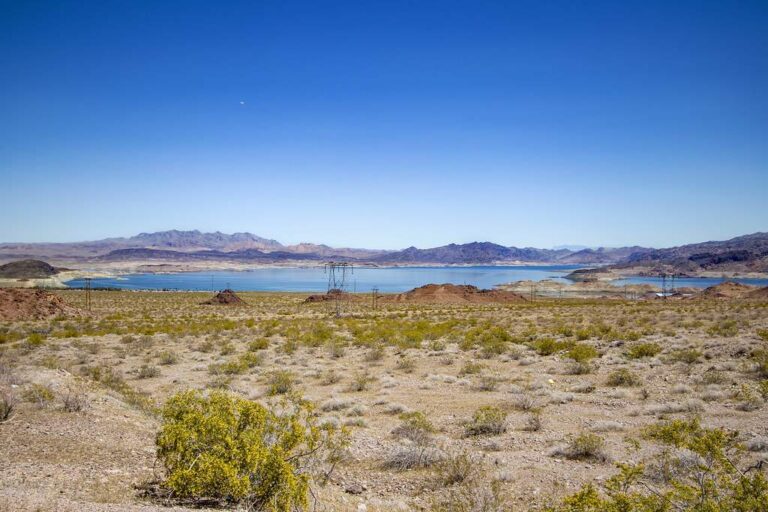
Photo of Lake Mead: Renee Grayson, CC BY 2.0
Who counts as a resident and where Arizona licenses are sold
Resident: domiciled in Arizona for the six months immediately preceding application, or active-duty military (or spouse) stationed in Arizona, or listing Arizona as home of record (booklet pp.1 and 7; A.R.S. 17-101A17, 17-336 not parsed).
About 150 license dealers statewide (sporting goods, bait and tackle, major retailers, convenience stores), Arizona Game and Fish Department offices, and online at azgfd.gov with immediate print-out.
All Community Fishing Program waters require anglers 10 or older to be licensed: General Fishing, Youth Combination, Combination Hunt and Fish, or Pioneer, Blind, Disabled Veteran, Short-term (one day) and youth group licenses (booklet p.29).
License prices as printed on p. 1 of the 2025 & 2026 Arizona Fishing Regulations (AZGFD PDF); azgfd.com did not answer automated reads, so the booklet is the only source, read November 16, 2026.
The Arizona statewide limit chart, line by line
The rules here are from the 2025 & 2026 Arizona Fishing Regulations, open January 1, 2025 through December 31, 2026 and amended January 30, 2026; AZGFD had approved no 2027 booklet that this site could find when it was checked.
Statewide possession limits are twice the daily bag limit for each species unless a different possession limit is specified by water.
| Chart row as printed | Daily limit | Note |
|---|---|---|
| Trout (includes rainbow, cutthroat, brown, brook, tiger, Gila and Apache trout; grayling) | 4 a day (Any combination) | Any combination |
| Bass (including largemouth and smallmouth) | 6 a day (Any combination) | Any combination |
| Striped Bass | 10 a day | |
| Walleye | 6 a day | |
| Northern Pike | no daily limit (Immediate kill or release) | Immediate kill or release |
| Catfish (including channel and flathead) | 10 a day (Any combination) | Any combination |
| Crappie (white and black) | no daily limit | |
| White Amur (grass carp) minimum size 30 inches | 1 a day | |
| Roundtail Chub | Catch and release only | |
| Sunfishes (includes bluegill, redear sunfish, green sunfish and hybrid sunfish) | no daily limit | |
| All Other Species (except protected native fish): including, but not limited to, white bass, yellow bass, common carp, suckers, buffalofish, bullhead, yellow perch and tilapia | no daily limit |
2025 & 2026 Arizona Fishing Regulations, p. 4 (open January 1, 2025 through December 31, 2026; AZGFD PDF), read November 16, 2026.
Rods, bait, closures and other rules that apply on every Arizona water
| Topic | What the booklet says |
|---|---|
| Two rods | All new fishing and combo licenses allow the angler to fish with two poles or lines simultaneously. In no case are more than two lines allowed at the same time. |
| Lures and flies | "Artificial flies and lures" means man-made devices intended as visual attractants; living or dead organisms, edible parts, natural or prepared food stuffs, or scent/flavor materials are not artificial flies or lures (R12-4-301). |
| Other legal methods | Bow and arrow, crossbow, snare, gig, spear or spear gun, or snagging are valid for common carp, buffalofish, mullet, tilapia, goldfish and shad statewide unless a closure or Special Regulation restricts it. Bow-and-arrow fishing for catfish (5 daily, any combination) is valid at Apache, Canyon and Saguaro lakes. |
| Taking bait | Live bait may be taken by minnow trap, dip net, cast net, pole and line, handline, crayfish net or seine. Cast nets may not exceed a 4-foot radius (8-foot diameter); seine nets 10 feet by 4 feet. |
| Possession and bag | Possession limits are twice the daily bag limit unless otherwise noted. Daily bag limits are for 24-hour periods (midnight to midnight) and apply to all Arizona waters fished that day; on multiple waters the statewide daily limit still applies. |
| Measuring length | Total length is the standard (jaw closed, tail lobes squeezed together). Most Arizona waters have no length limits. |
| Moving fish | It is illegal to transport live fish, including in live wells; all fish must be killed or released before leaving the water (designated live baitfish from licensed dealers excepted). Fish must be transportable so they can be counted and identified: a piece of skin must stay on the carcass or fillets; where minimum lengths apply, head, tail and skin must be intact. |
| Closed areas | Sensitive areas may be permanently closed to fishing. Some streams under native trout recovery may be temporarily closed. |
| Colorado River reciprocity | Licenses allow fishing from a boat on any portion of the Colorado River and impounded waters (e.g., Lake Mead, Lake Mohave, Lake Havasu) that form mutual boundaries between Arizona and California or Nevada, and from the California or Nevada shoreline of these waters (privileges of the pre-2014 Colorado River stamps are included). |
| Illegal stocking | It is illegal to stock fish or aquatic wildlife including crayfish, frogs, waterdogs and turtles. It is illegal to release live fish into a body of water they did not come from, or to transport live fish away from the water where caught (baitfish excepted). |
| Crayfish | Live crayfish may be used as bait only in the same water where caught; it is unlawful to transport live crayfish except in the part of southwestern Arizona south of I-10 and west of Highway 95 (Yuma County and a portion of La Paz County, p.7). |
| Tribal lands | R12-4-117 (printed in the booklet’s Commission Rules): a state license, permit or tag is not required to hunt or fish on any Indian reservation in this State; tribal permits and rules are set by each tribe and are not in the booklet. The booklet map marks Tribal Lands as outside the regions’ listed waters. |
2025 & 2026 Arizona Fishing Regulations, p. 5 (open January 1, 2025 through December 31, 2026; AZGFD PDF), read November 16, 2026.
Water-by-water entries for each AZGFD fishing region
- Pinetop regionRegion 1: chart exceptions, closures and every special-regulation water in the booklet
- Flagstaff regionRegion 2: chart exceptions, closures and every special-regulation water in the booklet
- Kingman regionRegion 3: chart exceptions, closures and every special-regulation water in the booklet
- Yuma regionRegion 4: chart exceptions, closures and every special-regulation water in the booklet
- Tucson regionRegion 5: chart exceptions, closures and every special-regulation water in the booklet
- Mesa regionRegion 6: chart exceptions, closures and every special-regulation water in the booklet
2025 & 2026 Arizona Fishing Regulations, p. 10-30 (open January 1, 2025 through December 31, 2026; AZGFD PDF), read November 16, 2026.
Community Fishing waters have their own Arizona limits
A set of city and county ponds sits in the Community Fishing Program, with limits of its own and a license required for anglers 10 and older.
Arizona Community Fishing waters
Protected native fish in Arizona
2025 & 2026 Arizona Fishing Regulations, p. 22 (open January 1, 2025 through December 31, 2026; AZGFD PDF), read November 16, 2026.
Live bait rules and aquatic invasive species steps for Arizona boats
Live baitfish legal in Arizona are only those species identified on pages 8-9; fathead minnows (most common), golden shiner and goldfish may be bought from licensed Live Bait Dealers.
No live baitfish may be used or possessed while on any waters in Coconino, Apache, Navajo, Pima and Cochise counties. All other counties have specific baitfish regulations by body of water or area.
AIS Protocols (A.R.S. 17-255, Director’s Order 3): day users (5 days or less on AIS-listed waters) clean and remove clinging material, remove the plug and drain all residual water (plug out during transport), and dry completely before use in another water. Long-term users and moored boats (6 consecutive days or longer) contact the AIS Program (recommended 72 hours notice), clean and drain, then keep the boat out of the water and dry a minimum of 18 consecutive days November through April or 7 consecutive days May through October; boaters receive a seal and receipt. AIS Program: 623-236-7608.
AIS-affected waters (Director’s Order 2, list effective June 19, 2023): Lake Powell (quagga mussel); Lake Mead (quagga mussel, New Zealand mudsnail); Lake Mohave (quagga mussel, New Zealand mudsnail); Lake Havasu (quagga mussel, didymo); Lower Colorado River (quagga mussel, New Zealand mudsnail, giant salvinia, apple snail, water hyacinth, didymo); Lake Pleasant (quagga mussel); Lees Ferry (quagga mussel, New Zealand mudsnail, didymo); Lower Salt/Verde River (quagga mussel, apple snail, New Zealand mudsnail); Apache Lake (quagga mussel, golden algae); Canyon Creek (New Zealand mudsnail); Canyon Lake (quagga mussel, golden algae); Oak Creek (New Zealand mudsnail); Saguaro Lake (quagga mussel, golden algae); Tonto Creek (New Zealand mudsnail); Roosevelt Lake (golden algae); Red Mountain Park Lake (quagga mussel, apple snail). Check azgfd.gov/ais for the current list (not reachable from this run).
2025 & 2026 Arizona Fishing Regulations, p. 8 (open January 1, 2025 through December 31, 2026; AZGFD PDF), read November 16, 2026.
The Arizona free fishing day under the booklet
Fishing any public water on free fishing day requires no license; day usually takes place on the first Saturday of National Fishing and Boating Week (booklet p.1). Statewide limits and regulations still apply.
The booklet prints June 7, 2025 for 2025 and June 6, 2026 for 2026; it printed no 2027 date.
2025 & 2026 Arizona Fishing Regulations, p. 1 (open January 1, 2025 through December 31, 2026; AZGFD PDF), read November 16, 2026.
Arizona license and rules, answered
What does an Arizona fishing license cost?
Anglers 10 and older need a valid Arizona fishing or combination license on publicly accessible water; the 2025 & 2026 Arizona Fishing Regulations prints $37 for a resident General Fishing license and $55 for a nonresident, each good for one year from the date of purchase.
How long does an Arizona license last?
Licenses are valid one year from date of purchase; non-transferable and non-refundable.
Do children need an Arizona fishing license?
Anglers under 10 need none; the booklet’s license rule starts at age 10.
Who counts as an Arizona resident?
Resident: domiciled in Arizona for the six months immediately preceding application, or active-duty military (or spouse) stationed in Arizona, or listing Arizona as home of record (booklet pp.1 and 7; A.R.S. 17-101A17, 17-336 not parsed).
Which Arizona booklet applies now?
The rules here are from the 2025 & 2026 Arizona Fishing Regulations, open January 1, 2025 through December 31, 2026 and amended January 30, 2026; AZGFD had approved no 2027 booklet that this site could find when it was checked.
Do I need a trout stamp or a Colorado River stamp?
No trout stamp, two-pole stamp, Colorado River stamps (CA/NV) or Utah Lake Powell Reciprocal License is required or sold; all fishing licenses cover trout and two lines.
What may an Arizona cooler hold after a move between waters?
Statewide possession limits are twice the daily bag limit for each species unless a different possession limit is specified by water.
How many rods may I use in Arizona?
All new fishing and combo licenses allow the angler to fish with two poles or lines simultaneously. In no case are more than two lines allowed at the same time.